

You Don't Have a Bloating Problem. You Have a Motility Problem.
The reason probiotics, removing foods, and digestive enzymes haven't fixed it, and what to look at instead.

There is a version of this story I hear all the time.
You’ve tried digestive enzymes, probiotics, cutting out gluten, cutting out dairy, maybe going low FODMAP for a few miserable months. Something helped a little, for a while. Then it stopped working, or it never fully worked, and now you’re standing in the supplement aisle wondering what you’re missing.
Here’s what I want to tell you: you’re probably not missing a supplement. You’re missing a framework.
Let me explain what I mean.

The symptoms that don’t get talked about together
When someone describes their gut issues to me, I’m listening for a specific cluster. It usually sounds something like this: low belly bloating that makes it hard to eat anything. No real hunger, even when you haven’t eaten in hours. A heavy, stuck feeling either in the center of the abdomen or just under the left rib. Constipation that’s inconsistent, so you can’t even predict it. Skin reactions that seem random. Fatigue that isn’t explained by how much you slept.
These symptoms look scattered. A doctor might address each one separately, or wave them off entirely. But when I see this picture together, I’m thinking about one thing: motility.
Motility is the coordinated muscular movement that moves food through your digestive tract. It's not the first thing most people think about when they're bloated. Most protocols jump straight to probiotics, enzymes, or removing foods. But motility is the underlying mechanism behind almost every symptom I just listed
What “no hunger” is actually telling you
Hunger isn’t just about blood sugar or willpower. It’s a signal. Your stomach sends a hormonal message to your brain that says “I’m empty, I’m ready, let’s go.” That message depends on your stomach actually emptying properly between meals.
If you have no appetite, especially in the morning, or you get full after just a few bites, your stomach is likely not clearing the way it should. Food is sitting longer than it’s supposed to. Your body doesn’t send the hunger signal because as far as it’s concerned, you’re still digesting the last thing you ate.
This is why eating less or eating lighter doesn’t always fix the fullness feeling. The problem isn’t how much you put in. It’s how slowly it’s moving.
The stuck feeling under your rib
That sensation of food being stuck in the center of your abdomen, or pressing up under your left rib, often maps to the transverse colon. This is the section of the large intestine that runs horizontally across your abdomen. When motility is sluggish here, things literally sit and accumulate. The distension is real. The discomfort is real. And no amount of probiotic strains is going to fix a mechanical problem.
Why digestive bitters helped but didn’t solve it
Bitters stimulate digestive secretions, bile flow, and stomach acid production. They work upstream. So if bitters gave you some relief, that’s actually useful information. It tells me your digestion can respond. Your body wants to work. But bitters act on the signalling side of digestion. They don’t directly address what happens after food leaves the stomach.
If your improvement with bitters plateaued, it’s likely because the bottleneck shifted. You improved one piece of the process, but the motility issue further downstream was still there.
The skin reactions and the low mood
Your gut and skin share a drainage system. When things aren’t moving well in the intestines, there’s more opportunity for bacterial byproducts, endotoxins, and inflammatory compounds to recirculate. The skin is one of the body’s backup elimination pathways. Reactions, flares, and random breakouts that don’t respond to topical treatments are often the skin trying to do what the gut isn’t.
And the low mood. I hear this a lot: “I know I’m not depressed, I’m just frustrated from feeling this way every day.” But there’s also a more direct connection. The vagus nerve links your gut and your brain, and when motility is poor, the signalling along that nerve is often dysregulated too. Your nervous system is not separate from your digestive system. They talk constantly.
So what actually addresses motility?
This is where it gets nuanced, because motility issues don’t all have the same root. For some people it’s a nervous system regulation piece. For others it’s connected to thyroid function, to sex hormone levels, or to something that happened during an illness or a period of prolonged stress. The approach that works has to match the underlying driver.
But if I’m looking at this from a functional lens, one of the first places I go is minerals.
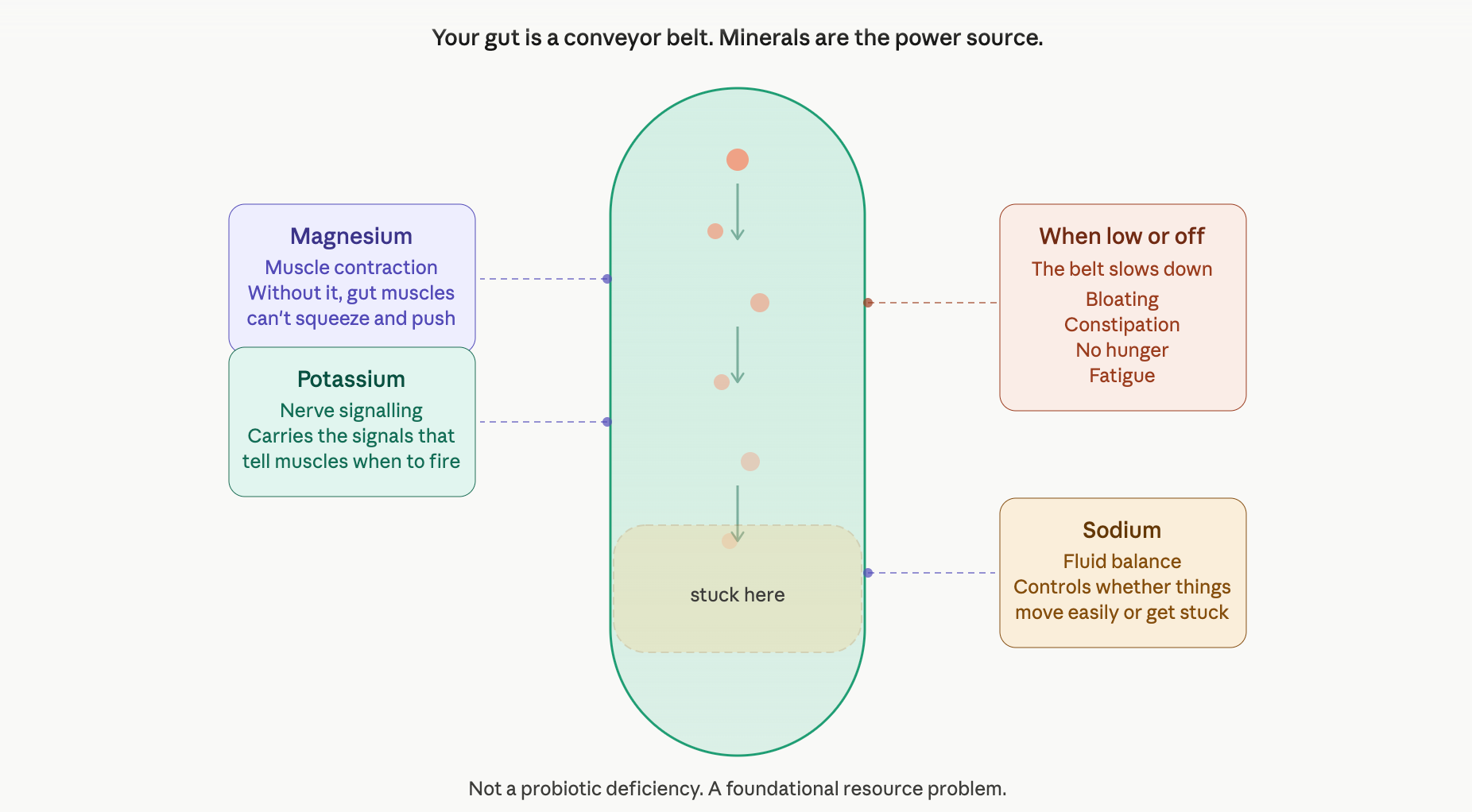
Think of your digestive tract like a conveyor belt. For that belt to move, it needs power. That power comes from minerals.
Magnesium tells your gut muscles to contract and push food through. Potassium carries the nerve signals that keep everything coordinated. Sodium manages the fluid balance that determines whether things move easily or get stuck.
When any of these are low or out of balance, the conveyor belt slows down. It’s not that your body has given up on you. It’s that it’s been trying to do its job without the basic materials it needs to do it.
This is what I see consistently when I look at mineral patterns in women with this symptom picture. Not a probiotic deficiency. A foundational resource problem.
This is where HTMA comes in. HTMA stands for hair tissue mineral analysis, and it gives me a window into something blood work simply doesn’t show.
When your doctor tests your blood, they’re looking at a tightly controlled environment. Your body works extremely hard to keep blood levels stable, so hard that it will pull minerals from your cells, your tissues, even your bones, just to keep those numbers in range. Which means blood can look perfectly normal while your cells are running on empty.
Hair tissue tells a different story. It reflects what’s actually been happening inside your body at the cellular level over the past three months. Not what your body managed to maintain on the surface, but what’s really been available to run your digestion, your hormones, your nervous system. That’s the difference between managing symptoms and actually understanding them.
If you’re not familiar with HTMA testing, I share all about it in this post.
I'm not saying minerals are always the answer. But most gut health advice skips straight to bacteria and food triggers. What rarely gets asked is whether the digestive system has the foundational resources it needs to actually function. Whether the muscles lining your gut can contract. Whether the nerves can fire. Whether the fluid balance is right. Those questions come before probiotics. They come before any type of diet. And they almost never get asked.

If any of this sounds like you
The symptoms described here, no hunger, low belly distension, stuck feeling, inconsistent constipation, fatigue, skin reactions, are not random. They’re not a sign that you’ve tried everything and your body just doesn’t respond. They’re a sign that the framework hasn’t matched the problem yet.
That’s fixable. But it usually requires starting in a different place than most people start.
Most women I work with have been in this cycle for years. Not because they weren’t trying hard enough or didn’t do enough research. But because nobody had ever looked at the full picture with them. That’s what I want to do with you.
You've done the research. You've tried the things. What you haven't had yet is someone sit down with your specific story and tell you what it actually means. That's what the Gut Relief Audit is. I go through your complete symptom history, your timeline, and everything you've already tried. Within 72 hours you get a clear breakdown of what's driving your symptoms and what I'd actually address first. You can grab your Gut Relief Audit here.
Your Turn
Before you go, I want to hear from you. How long have you been dealing with bloating, constipation, or gut symptoms that nobody has been able to explain? Drop it in the comments. I read every one and I respond personally.
Because the thing I hear most from women in this situation is that they’ve never had anyone actually listen to the whole story. This is a good place to start.